


With their fresh perspective, early career scientists make valuable contributions to the field. The Institute for Global Health Sciences Affiliate Program recognizes early-career individuals making exceptional contributions to teaching, mentoring, collaboration, or other scholarly work in global health.
In 2025, the Institute recognized four individuals with Early Career awards for their outstanding promise to the field of Global Health. Learn more about this year’s awardees:
2025 Awardees:
David B. Bayne, MD, MPH

David Bayne, MD, MPH, is an Assistant Professor of Urology and Director of Global Education and Simulation at UCSF. He was recently named Chief of Urology at Zuckerberg San Francisco General Hospital and Trauma Center. Bayne is one of the few early-career urologists whose research focuses on the intersection of social determinants of health and surgical innovation.
Bayne specializes in kidney stone disease, using it as a lens to explore inequities in care. He is known for building and sustaining long-term partnerships and has traveled to Uganda multiple times to collaborate with national urology faculty. He also helped launch a new urologic oncology fellowship, which will train the first generation of urologic cancer surgeons in Uganda and the region.
Bayne is dedicated to integrating data science with health equity and conducting innovative, equity-driven global health research. As part of this work, Bayne has a long-term collaboration with Georgetown Hospital in Guyana, supported by the UCSF for Health Equity in Surgery and Anesthesia (CHESA) early-career research award. He is also the deputy director and director of research at CHESA and a dedicated mentor to trainees and scholars from backgrounds underrepresented in medicine and surgery, and a key leader behind the monthly Works in Progress series — a highly active hub for collaborative scholarship. Across his many roles, his work seeks to expand access to surgical and urologic care in the U.S. and globally.
Lakshmi Gopalakrishnan, PhD
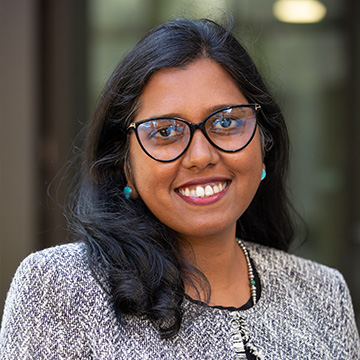
Lakshmi Gopalakrishnan, PhD, is a population and behavioral health scientist whose work centers on advancing gender equality and women’s empowerment through public health research. Gopalakrishnan’s work is focused on addressing women’s health disparities through culturally responsive, evidence-based interventions.
Gopalakrishnan is known for her methodological innovation that challenges the traditional woman-only focus in reproductive health research by incorporating partner influence and relationship dynamics. This work also challenges entrenched patriarchal norms by promoting shared responsibility and communication in households. Her work focuses on household-level gender transformation, not just women’s individual behavior — setting her apart from conventional approaches. This research seeks to change underlying power structures rather than working around them.
Gopalakrishnan’s work also merges behavioral science, technology, and cultural nuance. For example, she developed a couples-focused chatbot that improves family planning communication in Nepal with funding from a RAP grant.
Gopalakrishnan mentors emerging researchers in the global south and UCSF Masters students. She was selected for WomenLift Health’s North America leadership program and has won awards for her work in health equity and women’s health.
Lia Jacobson, MD

Lia Jacobson, MD, is a pediatric ear, nose and throat specialist, or otolaryngologist. She Co-Directs UCSF Benioff Children’s Hospital San Francisco’s Multidisciplinary Aerodigestive Center and the Trach-Vent Clinic. Jacobson’s contributions span clinical innovation, training, mentorship, capacity building, and program development across multiple countries. She is committed to improving surgical education and surgical equity globally.
Jacobson is Co-Director for the Center for Health Equity in Surgery and Anesthesia’s Fellowship, a multidisciplinary program that supports emerging, international leaders in perioperative health equity. Her leadership has contributed to CHESA’s reputation as a globally prominent and innovative program. She works directly with ENT training programs in East Africa and Southeast Asia, focusing on the development of fellowship-level pediatric otolaryngology training, residency education through long-term, bidirectional academic partnerships, and capacity-building in pediatric airway safety.
Jacobson is known for her grounded leadership rooted in equity, partnership, and sustainability. She personally mentors more than 19 trainees, including UCSF students, residents, otolaryngologists, and global surgical trainees. She has long-standing partnerships in Tanzania, Uganda, and Cambodia where she supports clinical care, surgical training, local research capacity, and shifting programs from short-term surgical missions to long-term training and capacity building. Jacobson is a major force in shaping the future of global surgical and anesthesia training.
Hamid Sharifi, PhD, DVM

Hamid Sharifi, PhD, DVM, is a professor of Epidemiology at Kerman University of Medical Sciences in Iran and the director of the HIV/STI Surveillance Research Center, which is a WHO Collaborating Center for HIV Surveillance, located at KMU. Sharifi’s work centers on HIV prevention, harm reduction, stigma, and health equity for marginalized groups.
Sharifi served as project manager for a major bio-behavioral surveillance survey among women affected by HIV. He analyzed behavioral risk data and barriers to care to identify major gaps in outreach and testing and developed community-based education programs informed by the data. These programs increased HIV testing uptake by 30%+ in pilot provinces. His research has led to policy and practice changes like culturally resonant stigma-reduction campaigns and the integration of anti-discrimination modules into medical school curricula.
He is an active contributor and later mentor in UCSF’s International Traineeships in AIDS Prevention Studies (ITAPS) program and has both trained under and supported fellow early-career scientists in global health research and has organized and led workshops in multiple countries. Sharifi has also played a mentorship role in guiding and supervising numerous students in the fields of Epidemiology and Public Health, including 15 Ph.D. and 27 Master’s students.
Sharifi is recognized for using his pioneering epidemiological research and community engagement to address health disparities in the Eastern Mediterranean region.