


The UCSF Center for Malaria and Vector-Borne Diseases (CMVBD) hosted its second annual research symposium on October 15. Over 130 researchers, industry scientists, public health professionals, students, and funding partners came together from across the Bay Area for a lively day of lightning talks, presentations, panel discussions, and networking.
The first symposium in September 2025 marked the Center’s launch after a challenging nine months for global health researchers. “A year ago, when we launched the Center, the mood was somber as funding for global health and infectious diseases had been cut a lot by the US government and internationally,” said Michelle Hsiang, MD, MS, Director of Research for the Malaria Elimination Initiative, and Co-Director of CMVBD. “It was actually from those challenges that the Center emerged as a place for people with a shared commitment to malaria and vector-borne diseases to come together to weather the storm. We support each other as a community, and I’ve seen many friendships and collaborations form. Now, one year later, the mood is much different.”

This year, the room at UCSF’s Mission Bay campus felt more positive, and imbued with a sense of pragmatic optimism. The agenda included poster and oral presentations, panels, and multiple rounds of research lightning talks covering three themes: immunology and diagnostics; vector biology, surveillance and control; and therapeutics for treatment and prevention. After each set of lightning talks by trainees and early- and mid-career investigators at UCSF, Stanford University, and UC Berkeley – many of which featured novel and exciting innovations such as mosquito gene drive and new therapeutic and vaccine approaches – several hands would shoot up to ask questions. In addition to researchers and staff, many students attended, interacted, and mingled throughout the day.
Erin Mordecai, PhD, an Associate Professor in Biology at Stanford, gave the keynote address on climate and mosquito-borne diseases. She shared her research on the non-linear relationship between temperature and transmission of mosquito-borne diseases, and how the optimum temperature for disease transmission is different for different diseases (e.g., dengue vs. malaria). Further, these relationships are impacted by local factors such as urbanization, land-use, climactic events, human movement, control interventions, and species dynamics, which can be studied individually and together, using mathematical models and empirical data from the lab and the field.
As part of a panel on tools and training platforms, CMVBD co-director Allison Tatarsky, MPH, presented on the Malaria Elimination Toolkit Assistant, an AI tool that helps users make full use of all the toolkit’s features, and UCSF Professor of Medicine Bryan Greenhouse, MD, MA, shared updates on the PlasmoGenEpi training platform on malaria genomic epidemiology.

Professor of Vector Biology and Infectious Disease Ecology at the University of Glasgow, Fredros Okumu, PhD, MBA, gave a talk where he discussed the possibility of eliminating the mosquito species that spreads malaria. Though it’s possible to eliminate a species, he argued, not all species are equally vulnerable, and attempting to do so could disrupt immunity that populations build up over time.
In the afternoon, a special session titled Global to Local – Bay Area Vector-Borne Diseases, brought together public health, epidemiology, vector biology, and communications experts from California health departments and mosquito abatement districts. The panelists discussed their best practices for preventing, managing, and investigating local vector-borne disease outbreaks. The panel impressed the audience with the success of local vector control efforts in limiting outbreaks of diseases such as West Nile Virus infection, as well as the transmission of dengue and malaria from imported cases.
Before the closing remarks, two CMVBD Rising Star Awardees were announced. The award recognizes early-stage investigators who demonstrate exceptional promise and commitment to advancing malaria and vector-borne disease research, public health practice, or policy impact. Jessica Briggs, MD, MA, Assistant Professor, Department of Medicine, was recognized for her leadership as a researcher and her capacity strengthening for malaria molecular surveillance in Uganda. Mercy Opiyo, PhD, MSc, Entomologist and Senior Program Manager, Malaria Elimination Initiative at IGHS, was recognized for her leadership and research in multi-country initiatives on malaria vector surveillance and control.
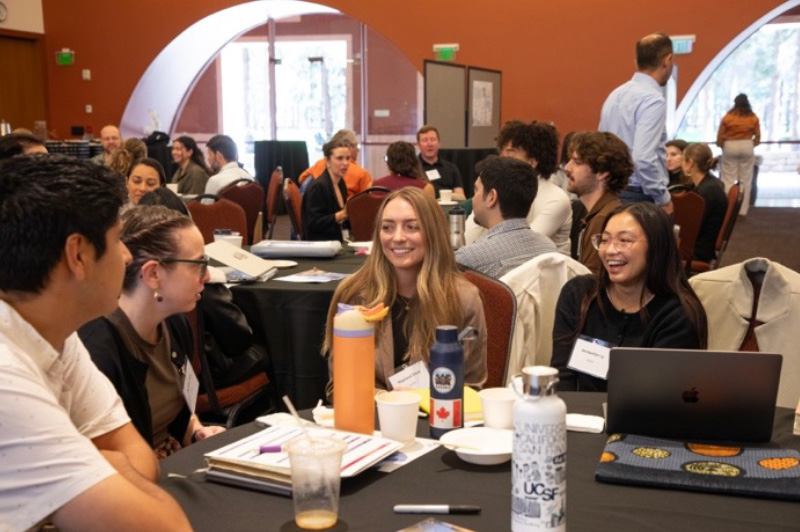
In her closing remarks, Michelle Hsiang summed up the day, noting that it takes both time and hard work to make a scientific discovery, but that it is meaningful to be in a room with so many people who are putting in such valuable work each day.
“The energy at the meeting was positive and invigorating. So many groups in the Bay Area are working on these diseases, tackling them from different perspectives, such as the host, the vector, and the pathogen, and from discovery all the way to implementation science. It was exciting to have so much talent and commitment together in the same room,” said Hsiang.
The symposium was sponsored by Novartis, the UCSF Division of HIV, Infectious Diseases, and Global Medicine, and the UCSF Institute for Global Health Sciences Affiliate Program.